
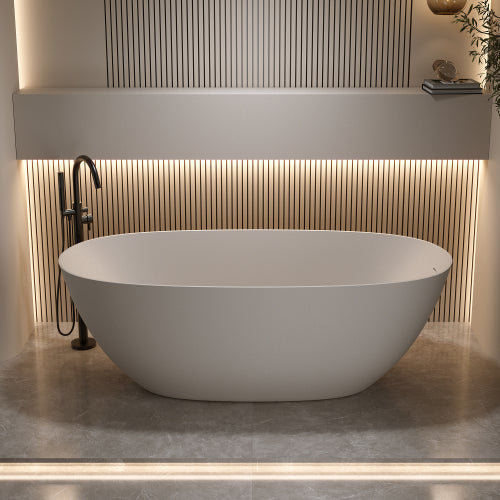
Choosing a freestanding bathtub is one of the most exciting decisions in a bathroom renovation — and one of the easiest to get wrong. The most common mistake isn’t picking the wrong style or material. It’s picking the wrong size.
A tub that’s too small for your height leaves your knees bent and your shoulders out of the water. A tub that’s too large for your bathroom overwhelms the space and makes the room feel cramped rather than luxurious. And a tub that’s sized right for your bathroom but wrong for your body delivers a soaking experience that never quite lives up to what you imagined.
This guide compares the three most common freestanding bathtub sizes in the US market — 47 inch, 51 inch, and 61 inch — across every dimension that actually matters: bathroom fit, user height, soaking depth, weight, and total cost. By the end, you’ll know exactly which size belongs in your bathroom.
Understanding Freestanding Bathtub Dimensions: What the Numbers Actually Mean
When a bathtub is listed as “51 inches,” that measurement refers to the exterior length of the tub from end to end. The interior soaking length — the space your body actually occupies — is typically 4 to 6 inches shorter, depending on the wall thickness of the tub and the design of the interior basin.
Width and height matter just as much as length, but they’re less often discussed. Width determines how much lateral space you have to relax your arms and shoulders. Height determines how deep the water gets — and how fully submerged you are during a soak. A tub that’s 19 inches tall holds meaningfully less water than one that’s 22 inches tall, and the difference in immersion is immediately noticeable.
With that context established, here’s how the three sizes compare.
The 47 Inch Freestanding Bathtub: Maximum Fit, Minimum Footprint

A 47 inch freestanding tub is the smallest size that still functions as a genuine soaking tub rather than a standard alcove replacement. At just under 4 feet long, it’s designed for bathrooms where floor space is genuinely constrained — urban apartments, guest bathrooms, and older homes where the bathroom footprint was never designed for a freestanding fixture.
Who It’s Right For
- Users under 5’5”: At 47 inches exterior length, the interior soaking length is approximately 41 to 43 inches — comfortable for users up to about 5’5” in a reclined position.
- Bathrooms under 60 square feet: With 18 inches of clearance required on all sides, a 47 inch tub needs a minimum floor space of roughly 83 inches × 61 inches (approximately 35 square feet of dedicated tub zone).
- Guest bathrooms: A 47 inch freestanding tub in a guest bathroom delivers the visual impact of a statement fixture without the spatial commitment of a larger model.
- Budget-conscious renovations: Smaller tubs cost less to manufacture, ship, and install — and they’re lighter, which simplifies installation and eliminates floor load concerns.
The Trade-Off
The 47 inch size works well for shorter users and compact spaces, but it’s a genuine compromise for anyone over 5’6”. The interior soaking length simply doesn’t allow for full-body recline at that height — you’ll be sitting more upright than lying back, which changes the character of the soaking experience significantly.
The 51 inch Freestanding Bathtub: The Sweet Spot for Most American Bathrooms

The 51 inch freestanding bathtub is the most popular size in the US market for good reason: it fits the majority of American primary bathrooms, accommodates most adult heights comfortably, and delivers a genuine soaking experience without the floor load and spatial demands of a larger tub.
The Airayvis 51 inch stone resin models measure 51″ L × 25.6″ W × 19.3″ H and weigh 205 lbs. Three versions are available — a warm beige at $1,699, a matte white with ergonomic waist curve at $2,399, and a turquoise green at $2,499 — all sharing the same exterior dimensions and solid surface stone resin construction.
Who It’s Right For
- Users between 5’4” and 5’10”: The interior soaking length of approximately 45 to 47 inches accommodates this height range comfortably in a reclined position. Users at the taller end of this range will find the ergonomic waist curve model particularly comfortable, as the curved backrest supports the lower back during extended soaks.
- Standard primary bathrooms (60–80 square feet): With 18 to 24 inches of clearance on all sides, a 51 inch tub requires a dedicated floor zone of approximately 87 inches × 61 inches — well within the footprint of most American primary bathrooms.
- Second-floor bathrooms: At 205 lbs, the 51 inch stone resin models are heavy but manageable for most second-floor wood-frame bathrooms. The total load with water and one occupant approaches 800 to 900 lbs — within the range of standard residential floor ratings in most cases, though a structural check is always advisable.
- First-time freestanding tub buyers: The 51 inch size is forgiving — it works in a wide range of bathroom configurations and suits a wide range of user heights, making it the lowest-risk choice for buyers who are uncertain about sizing.
The Trade-Off
Users over 5’10” will find the 51 inch tub comfortable but not ideal for full-body recline. The soaking experience is excellent, but taller users will notice that their legs are slightly bent rather than fully extended — which is fine for most people but may feel limiting for those who specifically want a full-stretch soak.

The 61 Inch Freestanding Bathtub: Spa-Grade Immersion for Larger Spaces

The 61 inch freestanding bathtub is where the soaking experience shifts from “very good” to “genuinely spa-grade.” At 61″ L × 30.7″ W × 22″ H and 321.87 lbs, the Airayvis 61 inch stone resin model is larger in every dimension — longer for taller users, wider for a more expansive interior volume, and taller for deeper water immersion.
The 22-inch height is the detail that matters most for the soaking experience. Compared to the 19.3-inch height of the 51 inch models, those 2.7 additional inches translate to meaningfully deeper water immersion — the difference between water at your chest and water at your shoulders. For a soaking tub, that’s a significant experiential upgrade.
Who It’s Right For
- Users 5’10” and above: The interior soaking length of approximately 55 to 57 inches accommodates full-body recline for users up to 6’2” or so. For taller users, this is the minimum size that delivers a genuinely comfortable soak.
- Large primary bathrooms (80+ square feet): With 18 to 24 inches of clearance on all sides, a 61 inch tub requires a dedicated floor zone of approximately 97 inches × 67 inches. This fits comfortably in larger primary bathrooms but will feel tight in standard-size spaces.
- Couples: At 30.7 inches wide, the 61 inch model is one of the few freestanding tubs that genuinely accommodates two people. The wider interior basin provides enough lateral space for two adults to soak simultaneously without feeling cramped.
- Buyers who prioritize the soaking experience above all else: The combination of greater length, greater width, greater depth, and the slow heat dissipation construction of the stone resin material produces a soaking experience that the 51 inch models, excellent as they are, simply cannot fully replicate.
The Trade-Off
The 61 inch model demands more from your bathroom and your building. It needs more floor space, it weighs 116 lbs more than the 51 inch models, and the total load with water and occupants can exceed 1,100 lbs — which requires floor load verification for second-floor wood-frame bathrooms. It also costs $2,999, which is $300 to $1,300 more than the 51 inch options. For buyers whose bathroom can accommodate it and whose budget allows it, none of these trade-offs are dealbreakers. But they’re real considerations that need to be addressed before purchase.
Side-by-Side Size Comparison
| Spec | 47 Inch | 51 Inch | 61 Inch |
|---|---|---|---|
| Exterior Length | 47″ | 51″ | 61″ |
| Exterior Width | ~25″ | 25.6″ | 30.7″ |
| Exterior Height | ~18″ | 19.3″ | 22″ |
| Weight (stone resin) | ~150 lbs | 205 lbs | 321 lbs |
| Ideal User Height | Under 5’5” | 5’4” – 5’10” | 5’10” and above |
| Good for Couples? | No | Tight | Yes |
| Min. Bathroom Size | ~50 sq ft | ~60 sq ft | ~80 sq ft |
| Floor Load Check Needed? | Rarely | Advisable | Always |
| Airayvis Starting Price | N/A | $1,699 | $2,999 |
How to Measure Your Bathroom Before You Buy
Before committing to any size, take these four measurements in your bathroom:
- Available floor length: Measure the longest unobstructed wall run where the tub will sit. Subtract 36 to 48 inches for the clearance zones on each end. The remaining length is your maximum tub length.
- Available floor width: Measure the perpendicular distance from the tub’s intended position to the nearest wall, vanity, or fixture. You need at least 18 inches of clearance on the sides — 24 inches is more comfortable and is the standard recommended by most designers.
- Door and hallway clearance: Stone resin tubs are delivered in one piece. Measure every doorway and hallway the tub will need to pass through during installation. A 61 inch tub that can’t fit through the bathroom door is a problem that’s expensive to solve after the fact.
- Drain rough-in location: The drain location in your floor determines where the tub can be positioned. Most freestanding tubs have some flexibility in drain placement, but your plumber should confirm compatibility before you order.
The Airayvis Freestanding Stone Resin Collection
Airayvis offers five freestanding stone resin bathtub models across the 51 inch and 61 inch size categories — in matte white, beige, and turquoise green, starting at $1,699. Every model is solid surface stone resin construction with integrated overflow and pop-up drain, and all ship to the contiguous United States.
- 51″ Beige Stone Resin Soaking Tub — $1,699 — Entry price, warm colorway, ideal for Japandi and Mediterranean aesthetics.
- 51″ Matte White with Ergonomic Waist Curve — $2,399 — Best soaking comfort in the 51 inch category.
- 51″ Turquoise Green — $2,499 — Statement colorway for design-forward bathrooms.
- 61″ Spa-Size Matte White — $2,999 — Spa-grade immersion, ideal for taller users and larger bathrooms.
→ Browse All Models & Compare Sizes
Frequently Asked Questions
What is the minimum bathroom size for a freestanding bathtub?
The minimum usable bathroom size depends on the tub length plus the required clearance zones. As a practical rule: a 47 inch tub needs at least 50 square feet of total bathroom space to feel comfortable; a 51 inch tub needs at least 60 square feet; and a 61 inch tub needs at least 80 square feet. These are minimums — the tub will fit, but the room may feel tight. For a genuinely comfortable experience with 24 inches of clearance on all sides, add 10 to 15 square feet to each of these figures. Always measure your specific bathroom rather than relying on general square footage estimates, since room shape affects usable space significantly.
Is a 51 inch bathtub big enough for a 6-foot person?
It depends on the specific tub and how you define “big enough.” A 51 inch exterior length typically translates to 45 to 47 inches of interior soaking length. A person who is 6 feet tall (72 inches) will not be able to fully extend their legs in a 51 inch tub — their knees will be bent at roughly a 30 to 45 degree angle. Many 6-foot users find this perfectly comfortable for soaking, particularly with an ergonomic backrest that supports the lower back. But if full-body extension is important to you, the 61 inch model is the right choice. The interior soaking length of approximately 55 to 57 inches accommodates users up to about 6’2” in a reclined position.
How much clearance does a freestanding bathtub need on each side?
The minimum recommended clearance is 18 inches on all sides — enough to step in and out safely and to clean around the tub. Most interior designers recommend 24 inches of clearance for a comfortable, visually balanced result. At 24 inches of clearance, the tub reads as a deliberate design element rather than a fixture that was squeezed into the available space. For the plumbing side of the tub (where the drain and supply lines connect), your plumber may need additional access space during installation — confirm this before finalizing the tub’s position.
Does a heavier bathtub mean a better bathtub?
For stone resin tubs, yes — weight is a direct proxy for material density, and density is what drives the heat retention, structural rigidity, and surface durability that make stone resin superior to acrylic. A 205 lb stone resin tub is heavier than a 70 lb acrylic tub because it’s solid all the way through rather than a thin shell over a hollow frame. That density is what keeps your bath water warm 20 to 30 minutes longer, what prevents the tub from flexing under weight, and what gives the surface its non-porous, long-lasting quality. Within the stone resin category, the 61 inch model at 321 lbs is heavier than the 51 inch at 205 lbs simply because it’s larger — the material quality is the same.
Can I install a 61 inch freestanding bathtub on the second floor of my home?
Yes, but floor load verification is essential before installation. A 61 inch stone resin tub weighs 321 lbs empty. Add approximately 500 lbs of water (60 gallons at 8.3 lbs/gallon) and one or two occupants, and the total load can reach 1,000 to 1,200 lbs. Standard residential wood-frame construction is typically rated for 40 lbs per square foot — which, distributed over the tub’s footprint, may or may not require reinforcement depending on your specific joist size, spacing, and span. A licensed contractor or structural engineer can assess your floor in under an hour. This is a one-time step that eliminates a potentially serious problem — it’s always worth doing before any heavy freestanding tub installation on an upper floor.
Ready to choose your size? The full Airayvis Freestanding Stone Resin Bathtub collection is available now — 51 inch models starting at $1,699, 61 inch spa-size at $2,999, with free shipping to the contiguous United States.
Share:
100% Blackout Blinds - The No-Drill Solution for Deeper, Darker Sleep in 2026
Best Freestanding Stone Resin Bathtubs for Modern Bathrooms in 2026