
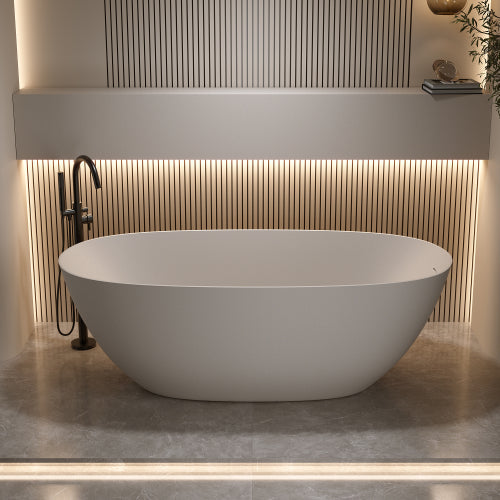

A freestanding bathtub is one of the most significant purchases in a bathroom renovation — and one of the most consequential to get wrong. Unlike a vanity or a tile choice, a bathtub is a fixture you’ll use daily for 15 to 25 years. The wrong size makes every bath uncomfortable. The wrong material means refinishing or replacement within a decade. The wrong placement creates plumbing problems that are expensive to fix after the fact.
This guide covers every decision you need to make before buying a freestanding bathtub in 2026 — in the order you should make them. By the end, you’ll know exactly what size, material, color, and model belongs in your bathroom.
Step 1: Measure Your Bathroom Before You Look at a Single Tub
The most common freestanding bathtub mistake is falling in love with a model before confirming it fits. Measure first. Shop second.
You need four measurements:
- Available floor length: The longest unobstructed run where the tub will sit. Subtract at least 18 inches from each end for clearance — 24 inches is the designer standard. The remaining length is your maximum tub length.
- Available floor width: The perpendicular distance from the tub’s position to the nearest wall or fixture. You need at least 18 inches of clearance on the sides; 24 inches is recommended.
- Door and hallway clearance: Stone resin tubs are delivered in one piece. Every doorway and hallway the tub passes through during installation must be wider than the tub. A 61-inch tub that can’t fit through the bathroom door is an expensive problem to solve after delivery.
- Drain rough-in location: The existing drain location in your floor determines where the tub can be positioned. Confirm with your plumber before ordering.
Once you have these measurements, you can determine which size category works for your bathroom.
Step 2: Choose the Right Size for Your Body and Your Bathroom

Freestanding bathtub sizes are measured by exterior length. The interior soaking length — the space your body actually occupies — is typically 4 to 6 inches shorter. Here’s how the three main size categories compare:
47 Inch — Compact, Renter-Friendly, Ideal for Smaller Spaces
At 47″ L × 25.6″ W × 19.3″ H and 191.8 lbs, the 47-inch tub is the smallest size that still functions as a genuine soaking tub. It’s the right choice for bathrooms under 60 square feet, users under 5’5”, and anyone who wants the visual impact of a freestanding fixture without the spatial demands of a larger model. The lighter weight also makes it the most installation-friendly option for second-floor bathrooms.
→ Airayvis 47″ Compact Matte White Stone Resin Tub — $2,099 $2,699
51 Inch — The Sweet Spot for Most American Bathrooms
At 51″ L × 25.6″ W × 19.3″ H and 205 lbs, the 51-inch tub fits the majority of American primary bathrooms and accommodates users between 5’4” and 5’10” comfortably. It’s the most popular size in the US market for good reason: it balances soaking comfort, spatial efficiency, and installation practicality better than any other size category. Three Airayvis models are available at this length — in matte white, turquoise green, and a matte white with ergonomic waist curve.
61 Inch — Spa-Grade Immersion for Larger Spaces and Taller Users
At 61″ L × 30.7″ W × 22″ H, the 61-inch tub is meaningfully larger in every dimension — longer for taller users, wider for a more expansive interior volume, and taller for deeper water immersion. The 22-inch height produces a noticeably deeper soak than the 19.3-inch models. It’s the right choice for users 5’10” and above, couples who want to soak together, and bathrooms of 80 square feet or more where the tub can breathe.
→ Airayvis 61″ Spa-Size Matte White Stone Resin Tub — $2,799 $3,499
Step 3: Choose the Right Material — Stone Resin vs Acrylic

Material is the most consequential decision in a freestanding bathtub purchase. It determines heat retention, surface longevity, structural feel, and total cost of ownership over the life of the tub. The two dominant materials in the US market are stone resin (solid surface) and acrylic.
Stone Resin: The Premium Choice
Stone resin is an engineered composite of crushed natural stone minerals and high-performance resins, solid all the way through. Its advantages over acrylic are significant and compound over time:
- Heat retention: Stone resin’s thermal mass keeps bath water warm 20 to 30 minutes longer than acrylic — the single most important performance difference for a soaking tub.
- Non-porous surface: No microscopic pores means bacteria, mold, and soap scum have nowhere to establish. Cleaning requires only mild soap and a soft cloth.
- No yellowing: Unlike acrylic, stone resin doesn’t contain UV-sensitive compounds. The matte white finish stays white for 20+ years without refinishing.
- Structural rigidity: Zero flex under weight. No hollow resonance. It feels like a permanent architectural element, not a plastic shell.
- Lifespan: 20 to 30 years with basic care, versus 10 to 15 years for acrylic before surface issues require refinishing or replacement.
Acrylic: The Budget Option
Acrylic is a thin thermoplastic shell reinforced with fiberglass. It costs less upfront ($400 to $900 for comparable sizes), is lighter and easier to install, and is widely available. Its limitations — poor heat retention, UV yellowing within 5 to 10 years, surface scratching, and a hollow feel underfoot — make it a rational choice for rental properties and short-term renovations, but a poor long-term investment for a primary bathroom you plan to keep.
For a soaking tub in a primary bathroom you’ll use for 10+ years, stone resin is the right material. The total cost of ownership over 20 years — accounting for acrylic refinishing or replacement — often makes stone resin the more economical choice despite the higher upfront price.
Step 4: Choose Your Color

Freestanding bathtub color is a design decision that’s easy to overthink. Here’s a simple framework:
Matte White — The Timeless Default
Matte white is the defining finish of contemporary American bathroom design — clean without being clinical, modern without being cold. It works in virtually every bathroom palette and never looks dated. If you’re uncertain, matte white is the right choice. All Airayvis stone resin models are available in matte white.
Turquoise Green — The Statement Choice
Colored freestanding tubs are one of the defining bathroom design trends of 2025–2026 — a deliberate reaction against the decade-long dominance of all-white bathrooms. Turquoise green works particularly well against white or light grey tile, natural stone, and warm wood accents. If your renovation is centered on making a visual statement, the Airayvis 51″ Turquoise Green at $2,399 is the model that delivers it.
Quick rule: Cool-toned, contemporary bathroom → Matte White. Design-forward renovation where the tub is the focal point → Turquoise Green.
Step 5: Verify Floor Load Before You Order
This step is skipped by more buyers than it should be — and it’s the one that creates the most expensive problems after the fact.
A freestanding stone resin bathtub is heavy. The 47-inch model weighs 191.8 lbs empty. The 51-inch models weigh 205 lbs. The 61-inch model is significantly heavier. Add water (approximately 8.3 lbs per gallon for a 60-gallon fill) and one or two occupants, and the total load on your floor can reach 800 to 1,200 lbs depending on the model.
For first-floor bathrooms on a concrete slab, this is rarely a concern. Concrete slabs are rated for loads well above what any residential bathtub imposes.
For second-floor bathrooms with wood-frame construction, floor load verification is essential. Standard residential wood-frame floors are typically rated for 40 lbs per square foot — which may or may not require reinforcement depending on your specific joist size, spacing, and span. A licensed contractor or structural engineer can assess your floor in under an hour. Do this before you order, not after delivery.
Step 6: Understand the Plumbing Requirements
Freestanding bathtubs have different plumbing requirements than alcove or drop-in tubs, and getting this wrong creates costly rework.
- Drain rough-in: The drain in your floor must align with the drain location on the tub. Most freestanding tubs have a center drain. Confirm the rough-in location with your plumber before ordering.
- Faucet: Freestanding tubs do not include a faucet. You’ll need either a floor-mounted freestanding tub filler (the most common and visually cohesive pairing) or a wall-mounted faucet. Floor-mounted fillers require a separate supply line rough-in in the floor — plan this before the tile goes down.
- Overflow: All Airayvis stone resin models include an integrated overflow and pop-up drain. These connect to your rough-in plumbing during installation.
- Water supply: Freestanding tubs hold more water than standard alcove tubs. Confirm your water heater capacity can fill the tub to a comfortable temperature without running cold.
Step 7: Budget Realistically — Tub Price Is Only Part of the Cost
The purchase price of the tub is the most visible cost, but it’s not the only one. A realistic freestanding bathtub budget includes:
- Tub: $2,099 to $2,799 for Airayvis stone resin models
- Faucet / tub filler: $300 to $1,500 depending on style and brand
- Plumbing labor: $500 to $1,500 depending on complexity and local rates
- Floor reinforcement (if needed): $500 to $2,000 for second-floor installations requiring structural work
- Delivery and installation labor: Stone resin tubs are heavy — professional delivery and positioning is advisable for the larger models
Total installed cost for a stone resin freestanding bathtub in a US primary bathroom typically ranges from $3,500 to $7,000 depending on the model, faucet choice, and local labor rates. This is a meaningful investment — and one that adds measurable value to the home, particularly in markets where primary bathroom quality is a significant factor in resale pricing.
The Airayvis Freestanding Stone Resin Collection: All 5 Models

Every Airayvis freestanding bathtub is precision-crafted from solid surface stone resin, finished in a hand-polished matte surface, and includes an integrated overflow and pop-up drain. All five models ship to the contiguous United States.
-
47″ Compact Matte White — $2,099
$2,699
47″ × 25.6″ × 19.3″ | 191.8 lbs | Best for compact bathrooms and users under 5’5” -
51″ Matte White Classic — $2,299
51″ × 25.6″ × 19.3″ | 205 lbs | Clean contemporary profile, ideal for standard primary bathrooms -
51″ Matte White with Ergonomic Waist Curve — $2,299
$2,899
51″ × 25.6″ × 19.3″ | 205 lbs | Best soaking comfort in the 51″ category; ergonomic backrest supports lower back -
51″ Turquoise Green — $2,399
51″ × 25.6″ × 19.3″ | 205 lbs | Statement colorway for design-forward renovations -
61″ Spa-Size Matte White — $2,799
$3,499
61″ × 30.7″ × 22″ | Spa-grade immersion; ideal for taller users, couples, and large primary bathrooms
→ Browse All 5 Models at Airayvis
Frequently Asked Questions
How do I know which freestanding bathtub size is right for me?
Start with your bathroom dimensions and your height. Measure the available floor space and subtract 18 to 24 inches of clearance on all sides — the remaining length is your maximum tub size. Then match the tub length to your height: users under 5’5” are comfortable in a 47-inch tub; users between 5’4” and 5’10” are best served by a 51-inch model; users 5’10” and above should consider the 61-inch spa-size. If you’re between sizes, go larger — a tub that’s slightly too long is far more comfortable than one that’s slightly too short.
Do freestanding bathtubs require special plumbing?
Yes, in two important ways. First, the drain rough-in in your floor must align with the tub’s drain location — most freestanding tubs use a center drain, so confirm your rough-in position before ordering. Second, freestanding tubs don’t use wall-mounted faucets in the traditional sense — they pair with either a floor-mounted freestanding tub filler (which requires a supply line rough-in in the floor) or a wall-mounted faucet positioned at the end of the tub. Plan your faucet type before the tile goes down, because changing it afterward requires opening the floor or wall. Your plumber should be involved in the planning process before you finalize the tub position.
Is a stone resin bathtub safe for a second-floor bathroom?
Yes, with proper floor load verification. Stone resin tubs are significantly heavier than acrylic — the Airayvis 47-inch model weighs 191.8 lbs empty, the 51-inch models weigh 205 lbs, and the 61-inch model is heavier still. Add water and occupants and the total floor load can reach 800 to 1,200 lbs. Standard residential wood-frame floors are typically rated for 40 lbs per square foot, which may or may not require reinforcement depending on your specific joist configuration. A licensed contractor or structural engineer can assess your floor in under an hour — always do this before ordering for a second-floor installation.
How long does a stone resin freestanding bathtub last?
With basic care — mild soap, soft cloth, no abrasive cleaners — a stone resin bathtub maintains its appearance and structural integrity for 20 to 30 years. The matte finish is inherent to the material rather than a coating applied over it, so it doesn’t dull, peel, or require refinishing. The non-porous surface doesn’t harbor bacteria or develop the micro-scratches that make acrylic progressively harder to clean over time. Compare this to acrylic, which typically requires refinishing or replacement within 10 to 15 years due to yellowing, surface scratching, and stress cracking — and the long-term value of stone resin becomes clear.
What’s the total cost to install a freestanding bathtub in a US home?
The tub purchase price is only part of the total cost. A realistic installed budget for a stone resin freestanding bathtub in a US primary bathroom includes the tub ($2,099 to $2,799 for Airayvis models), a freestanding tub filler or faucet ($300 to $1,500), plumbing labor ($500 to $1,500), and potentially floor reinforcement for second-floor installations ($500 to $2,000 if needed). Total installed cost typically ranges from $3,500 to $7,000 depending on the model, faucet choice, and local labor rates. This investment adds measurable resale value to the home — a well-chosen freestanding tub in a primary bathroom is one of the highest-ROI bathroom upgrades in the current US real estate market.
Ready to choose? The full Airayvis Modern Freestanding Stone Resin Bathtub collection is available now — five models from 47 to 61 inches, starting at $2,099, with free shipping to the contiguous United States.
Share:
Best Freestanding Stone Resin Bathtubs for Modern Bathrooms in 2026